What a coffee roaster air permit application asks for
What a coffee roaster air permit application usually covers: emission sources, smoke, VOCs and particulates, afterburner data, stack details and records.
Short answer: A coffee roaster air permit application usually asks for each emission source (roaster, cooler, grinders, green coffee handling), the pollutants each one releases, the control equipment such as cyclones and an afterburner, stack details, production and fuel figures, and a plan for monitoring and record keeping. Requirements and thresholds differ by country and region.
The application form looks short until the section on emission sources. Then it asks for figures most roastery owners have never had to produce: exhaust air volume, stack height and exit temperature, the operating temperature of the afterburner, annual green coffee throughput, hours of operation. A plant planned without those figures in mind can end up redesigning its roof after the equipment is ordered.
Air permit systems differ a lot. Some regions exempt small roasters or ask only for a registration. Others require a permit for any roaster, or set the threshold by batch size, hourly throughput or fuel input. Many authorities separate a permit to build or install from a permit to operate. The pattern below describes what most of them ask in some form, so the right data is ready before the first meeting.
Why roasting is regulated at all
A roaster releases particulates (chaff fragments and fine smoke), volatile organic compounds driven out of the beans, odor, and the combustion gases of its burner. An afterburner adds its own combustion gases while it destroys most of the smoke and VOCs. None of this is unusual for a food plant, but the smoke is visible and the odor travels, so a roastery can draw complaints faster than a larger but quieter factory.
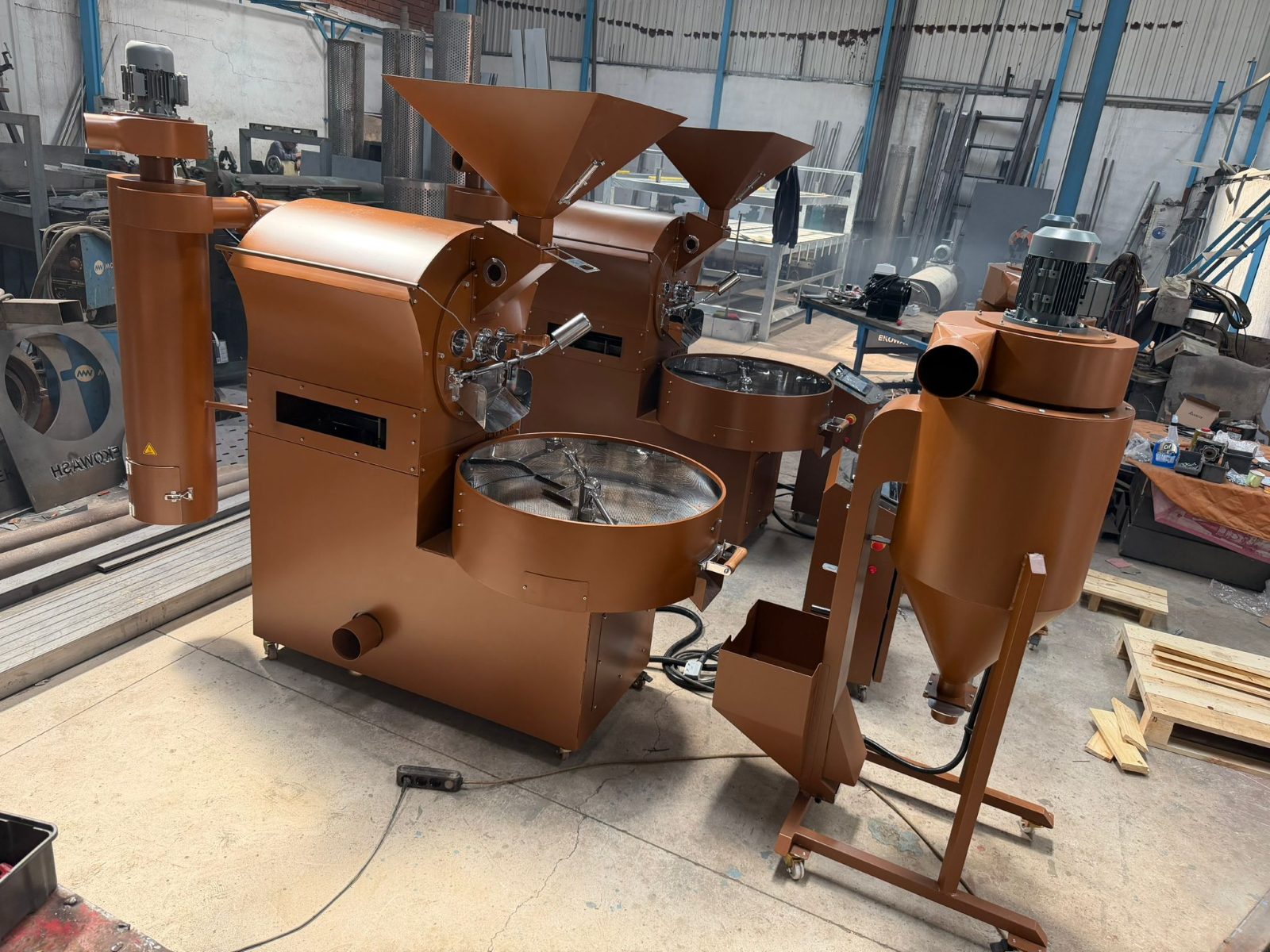
The sources the authority will list
The roaster stack is the obvious source. It is rarely the only one.
| Source | What leaves it | Typical control |
|---|---|---|
| Roaster exhaust | Smoke, VOCs, odor, fine chaff, burner gases | Roasting cyclone, then afterburner |
| Cooling exhaust | Chaff, dust, smoke at the drop | Cooling cyclone, stack placement |
| Afterburner | Combustion gases, heat | Burner setup and maintenance |
| Green coffee intake and conveying | Dust | Enclosed conveying, dust collection |
| Destoner and grinders | Dust | Enclosed equipment, filters |
| Chaff storage and handling | Dust, fire risk | Closed bins, regular emptying |
The cooling exhaust is easy to forget. It moves a large air volume, and at the drop it carries a short, dense burst of smoke. Some authorities treat it as a separate point source with its own stack data.
What the application usually contains
- A site plan with the building, the stacks, property lines and the nearest homes, schools or offices.
- A process description from green coffee intake to packing.
- An equipment list with model, batch size, hourly capacity and burner rating for each item.
- Planned throughput per hour and per year, and the hours and days of operation.
- Fuel type and the rated input of each burner, roaster and afterburner.
- A description of the control equipment and how it is operated.
- Stack data: height above ground, diameter, exit temperature, exit velocity or air volume.
- In some regions, an emission estimate or a dispersion calculation prepared by a consultant.
- A monitoring and record keeping plan.
Kafgar provides the equipment data for items 3 and 5: batch size, roasting capacity, heat power and the afterburner specification. A KR-60, for example, is listed at 60 kg (132 lb) per batch, up to 180 kg of green coffee per hour and 93 kW heat power.
Afterburner data reviewers look at
If the plan includes an afterburner, the reviewer wants to know how it is designed and how you will prove it is running correctly. Expect questions about its operating temperature, the time the exhaust spends in the hot chamber, how the temperature is measured and recorded, and what happens if it falls. For a Kafgar afterburner, the operating data comes with the equipment documentation, so it can go straight into the application.
Some authorities ask whether a roast can start before the afterburner has reached temperature, and how operators are told when it has. Have a written answer for your specific setup. How the afterburner destroys smoke and VOCs is covered in afterburners and clean coffee roasting.
Stack details
Stack height and position often decide whether a permit is granted without conditions. The reviewer looks at height above the roof and above nearby buildings, the distance to windows and air intakes, and whether the outlet discharges vertically. A rain cap that pushes the plume down can draw an objection. Plan the stack together with the roasting line layout, not after it.
Records after start-up
Permits often come with conditions that run for as long as the plant operates. Common ones include:
- Production records: batches roasted, green coffee used per month or year.
- Fuel use for the roaster and the afterburner.
- Afterburner temperature records during roasting.
- Maintenance records for the afterburner, cyclones and ducts.
- A log of complaints and what was done about each one.
- In some cases an emission test by an accredited lab after start-up, and again at intervals.
A PLC roaster that saves batch data, and roast logs kept in Artisan or Cropster, cover the production part of this record with little extra work.
Start before the equipment is ordered
The permit can change the equipment list. An authority may require an afterburner on a roaster you planned to run without one, or a taller stack the roof structure has to carry. In some jurisdictions, installing equipment before the permit to build is granted is itself a violation. Adding a second roaster later usually means a permit change, so describe the planned final capacity in the first application if you can.
Frequently asked questions
Does a small shop roaster need an air permit?
It depends on the region. Some exempt roasters below a size or throughput threshold, others require a permit or registration for any roaster. Ask the local air quality authority before signing a lease.
Does fitting an afterburner guarantee the permit?
No. It removes most smoke and odor from the roaster exhaust, but the authority also looks at the cooling exhaust, dust sources, stack design and records.
Who usually prepares the application?
Many roasteries use a local environmental consultant or engineer who knows the authority's forms. The equipment maker supplies the technical data.
Do permit rules differ for gas and electric roasters?
Electric roasters have no burner gases, but they still produce roasting smoke, VOCs and odor from the beans. Most authorities look at those emissions in both cases.
Preparing your permit data with Kafgar
For a plant project we provide the equipment data your consultant needs and can include a Kafgar afterburner in the line from the first layout. See what a full line includes on the coffee roasting plants page.
Request a quote on WhatsApp or by email at [email protected].