Batch vs continuous coffee roasting: which system fits your plant
Batch vs continuous coffee roasting compared for plant planners: how each system works, where continuous roasters fit, and why most plants stay with batch.
Short answer: In batch vs continuous coffee roasting, the difference is coffee flow. A batch drum roasts a fixed load, drops it and starts again. A continuous roaster takes a steady stream of green coffee in and sends roasted coffee out without stopping. Continuous suits very long runs of one product. Batch suits plants with several products, frequent changes and per-batch records.
A continuous roaster never drops a batch. Green coffee goes in at one end, roasted coffee comes out at the other, and the machine can run that way for a whole shift on the same setting. For a plant that makes one product in very large volumes, that is attractive. For most other plants it is a constraint, and that should be settled before the equipment list is fixed.
Kafgar builds batch drum roasters only, from shop size up to the 500 kg (1,102 lb) KR-500. Continuous lines still have their place, and this article says where.
How a continuous roaster works
The general principle is the same across designs. Green coffee is fed at a controlled rate into a long roasting chamber, often a rotating drum or a cylinder with internal flights or a screw that moves the beans forward. Hot air passes through the moving bed. The time each bean spends inside, called residence time, is set by the feed rate and the speed at which the beans travel. Roast degree is controlled mainly by air temperature and residence time.
At the exit, the coffee passes straight into a continuous cooler, then to storage or grinding. There is no charge, no drop and no pause between loads. Once the line is stable, output is steady and the operator's job is to hold conditions, not to run a profile.
Designs differ a great deal between manufacturers, so details such as roast time, air temperature and heat recovery depend on the specific machine. The common thread is that the process is tuned for one steady state.
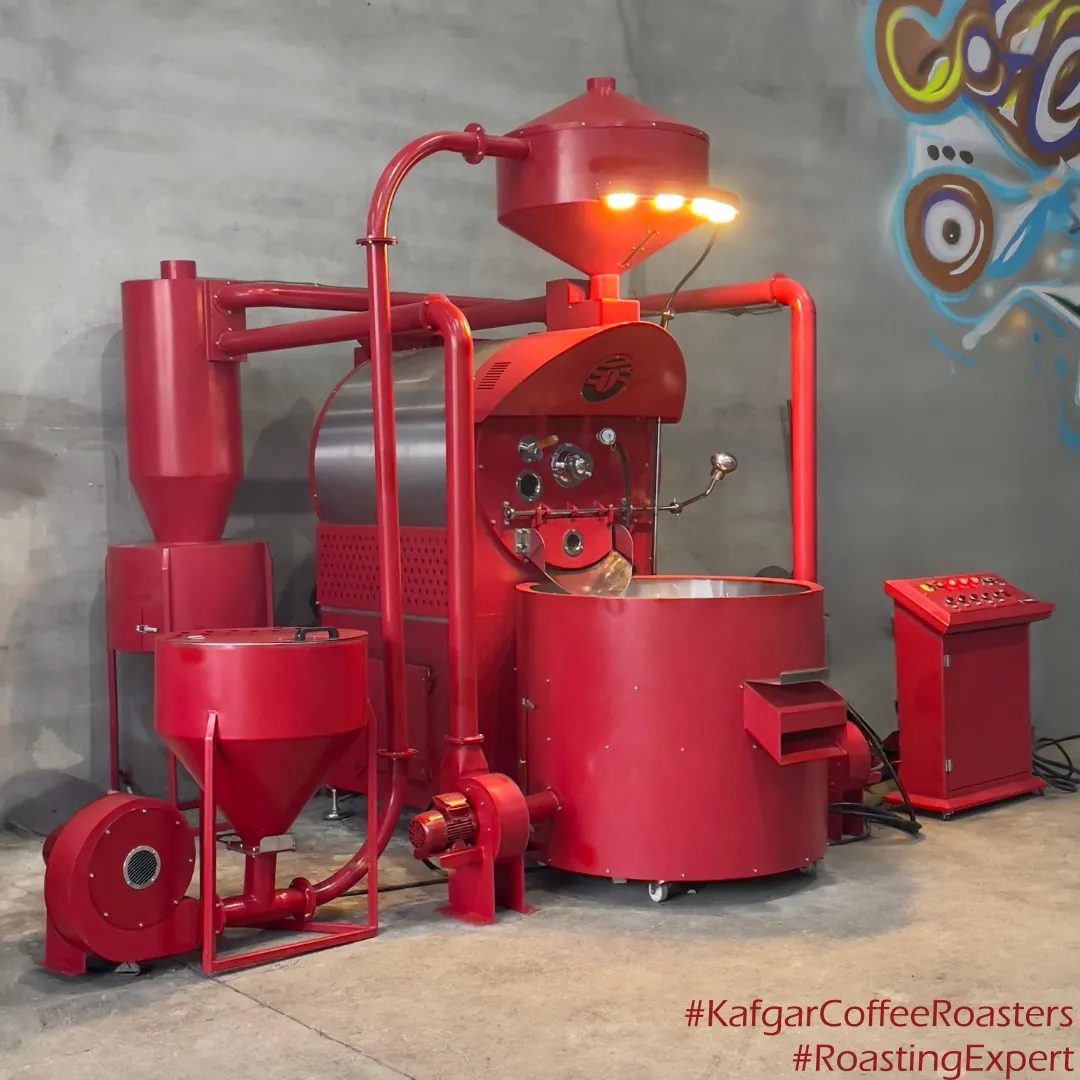
How a batch drum roaster works
A batch roaster charges a weighed load of green coffee into a hot rotating drum. Heat reaches the beans through the drum wall and through hot air pulled through the drum by the fan. The operator or the PLC follows a profile over the roast cycle, changing gas and airflow as the coffee passes through drying, browning and first crack. At the target, the whole batch drops into the cooling tray, and the next charge can go in.
On Kafgar industrial roasters the cycle is 12 to 16 minutes up to the KR-240, and 12 to 18 minutes on the KR-500. Each batch has a beginning and an end, and a roast curve that can be logged and compared. The post on how a drum coffee roaster works covers the mechanics in more detail.
Side by side
| Factor | Batch drum roaster | Continuous roaster |
|---|---|---|
| Material flow | Fixed load per cycle | Steady stream |
| Profile control | Full profile per batch, changeable by stage | Mostly steady state, set by temperature and residence time |
| Product changes | Between any two batches | Requires purging the line, with transition material |
| Traceability | One record per batch, linked to a green lot | Time-based records over a run |
| Small orders | Easy, one batch | Uneconomic below a long run |
| Start and stop | Routine every cycle | Start-up and shutdown take time and produce off-spec coffee |
| Typical use | Specialty, private label, multi-product plants | Very high volume, single product lines |
Where continuous roasting fits
Continuous roasters are usually found in plants that run a narrow range of products in very large, steady volumes. Mass-market ground coffee and coffee roasted for soluble production are typical examples. The coffee is often a consistent commodity blend, the roast degree changes rarely, and the line can run for long periods without a product change.
In that setting the advantages are real. Output is even, so downstream grinding and packing can be sized for a constant flow. Labor per tonne can be low. Heat can be managed as a steady load rather than a cycle that rises and falls.
Why most plants stay with batch
The limits of continuous roasting appear as soon as the product mix widens. Every change of coffee or roast degree means running the line through a transition, and the coffee roasted during that transition belongs to neither product. A plant that makes a light filter roast in the morning, a dark espresso in the afternoon and a private label order in between would spend much of its day in transition.
Profile control matters too. Many specialty and premium products depend on how the coffee moves through each stage of the roast, not only on the end color. A batch roaster can shape drying, browning and development separately. A continuous roaster is built to hold one set of conditions.
Then there are records. A batch has a number, a green lot, a weight in and a weight out, a curve and a color reading. That record is what private label customers and many retailers ask for. Achieving the same clarity on a continuous line is possible but harder, because lots blend at the boundaries.
Volume alone is rarely a reason to leave batch roasting. A single KR-500 handles 1,500 to 2,000 kg of green coffee per hour, and a plant can run two or more large batch roasters in parallel. With green coffee loaded by conveyor and elevator and profiles held by the PLC, a batch plant runs as an organized production line rather than a manual operation. The tour of what a complete coffee roasting plant needs shows how those pieces connect.
Questions to settle before choosing
- How many different roast products will the plant make in a typical week, and how often will it switch between them?
- What is the smallest order the plant must accept, for example private label or export samples?
- Do customers require a record per batch tied to a green lot?
- Will volume grow in steps, so that adding a second roaster later is easier than oversizing one line now?
- Is the product a stable commodity blend that rarely changes roast degree?
If the answers point to one product, very long runs and little change, a continuous line deserves a serious look. If they point to variety and records, batch is the safer base.
Frequently asked questions
Is continuous roasting more energy efficient than batch roasting?
It can be in steady operation, because a continuous line avoids reheating between cycles. Batch roasters narrow the gap with modulating burners, good insulation and short times between batches. The real answer depends on the specific machines and on how well each is run.
Can a batch roasting plant reach the output of a continuous line?
For most commercial volumes, yes. Running two or more large batch roasters in parallel with automatic loading gives high hourly output while keeping each product separate.
Does Kafgar make continuous roasters?
No. The roaster range runs from the KR-0.5 shop type model to the KR-500, all batch drums. Around them Kafgar also manufactures conveyors, elevators, destoners, afterburners and KM grinders.
Is a continuous roaster worth it for a specialty roastery?
Rarely. Specialty roasting relies on frequent product changes, small lots and per-batch profile control, which is what batch drums are built for.
Planning a batch roasting line
If the plant needs volume and variety at the same time, start from the target output per hour and the product mix, and the roaster count follows from there. The coffee roasting plants page shows the equipment Kafgar puts around the roasters, from green intake to grinding. With those two figures we can sketch a line around one or more batch roasters.
Request a quote on WhatsApp or by email at [email protected].