Coffee roaster exhaust ducting for industrial roasteries
Coffee roaster exhaust ducting basics: separate roasting and cooling exhaust, duct material, clearances, cleanout doors, bends, stack height and approval.
Short answer: Coffee roaster exhaust ducting should use rigid steel duct no smaller than the machine's outlet, keep roasting and cooling exhaust in separate runs, stay short with long-radius bends, have cleanout doors at every change of direction, keep clearance from combustible materials and end in a vertical stack above the roofline. A local engineer designs it and obtains approval.
The duct behind a roaster works as part of the roaster. The fan that pulls air through the drum has to overcome every meter of pipe and every bend after it, so the duct decides how much air actually moves through the beans. A roaster that behaved well during its factory test roast can roast slower, collect less chaff and smoke more on site if the ducting fights the fan.
Ducting is also where much of a roastery's fire risk sits. Fine chaff and oily residue settle wherever air slows down. Good design limits where that happens and makes those places reachable.
Two air streams that should stay apart
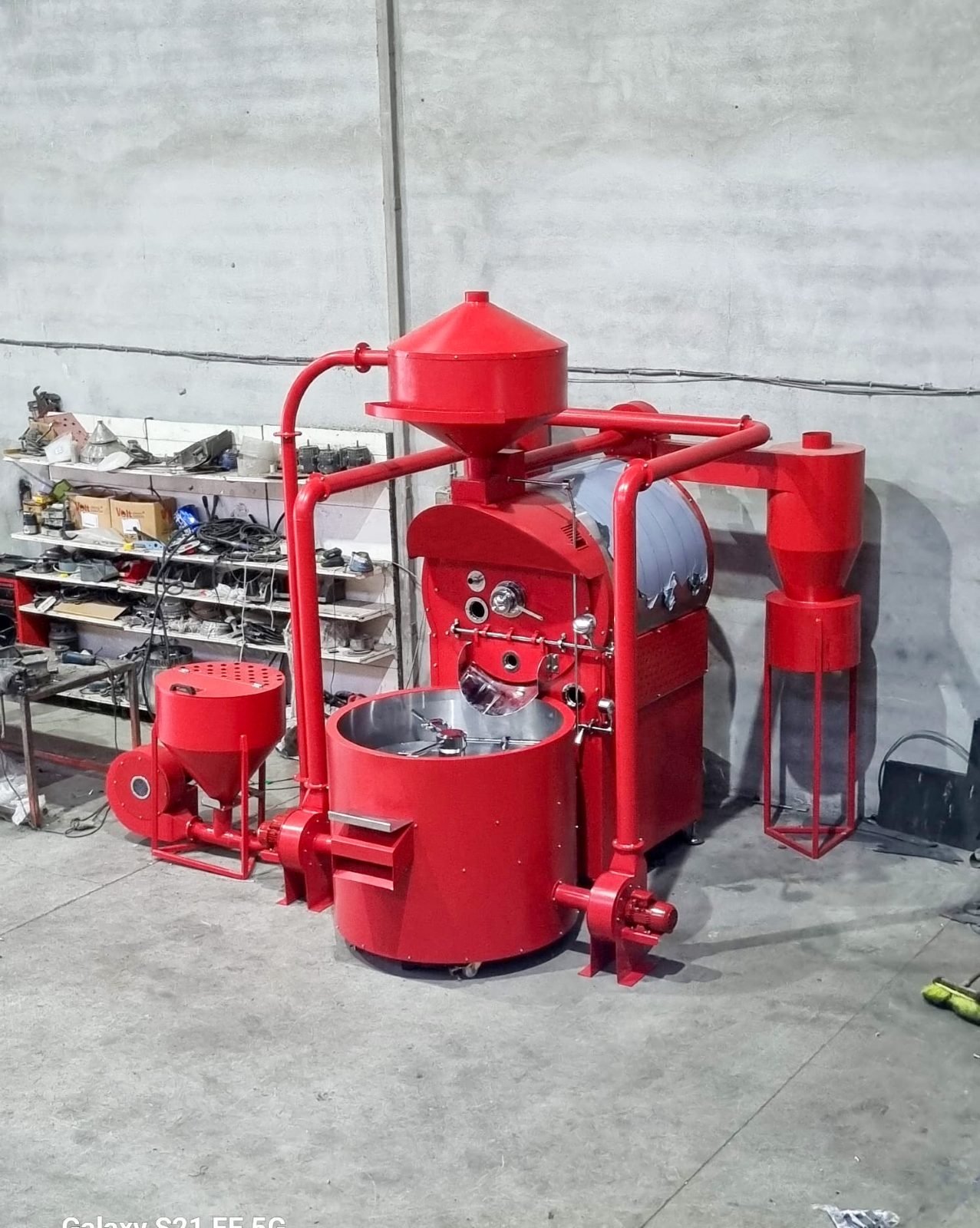
A drum roaster produces two separate exhausts. The roasting exhaust is the air drawn through the drum: hot, smoky, carrying fine chaff and oils. It passes the roasting cyclone, then the afterburner if one is fitted, and leaves through its own stack.
The cooling exhaust is room air pulled through the bean bed in the cooling tray. Kafgar roasters use air-vacuum cooling, which moves a large volume of air at a much lower temperature. That air carries chaff and dust, and a burst of smoke right after the drop, and it goes through its own cooling cyclone.
Joining the two into one duct causes trouble. Each fan starts to change the other's airflow, hot oily air meets dry chaff, and if there is an afterburner on the roasting side, it would have to heat the whole cooling volume as well. Keep the runs separate unless the equipment maker's design states otherwise.
Duct material and insulation
Use rigid, smooth-walled steel duct, with stainless steel common on the hot roasting side. Flexible foil hose, plastic and light ventilation duct do not belong on a roaster. They sag, trap chaff, cannot be cleaned properly and fail under heat.
Seal the joints. Downstream of the fan the duct is under positive pressure, and any leak pushes smoke back into the building. Support the duct on its own hangers so its weight does not rest on the roaster outlet or the cyclone.
Insulate or use double-wall duct where people can touch the hot run and where it passes through warm interior spaces. Outdoors, insulation keeps the gas warmer, which reduces condensation of water and oils on the inside walls. That condensate forms the sticky, tar-like layer that later feeds a duct fire. The section after an afterburner runs much hotter than the roasting duct, so it needs material and supports rated for that temperature.
Clearance to combustibles
Wherever the duct passes wooden beams, ceiling boards, roof insulation or stored materials, it needs a minimum clearance or a rated sleeve. The required distance depends on the duct type and the local building and fire code, so take it from your engineer and the duct manufacturer, not from another roastery.
Wall and roof penetrations should use a fire-rated sleeve or a listed penetration system. Keep the route out of attics and storage rooms, where nobody sees what is stacked against the duct.
Bends, length and the roaster fan
Every bend and every meter of duct adds resistance. Practical rules that apply to almost every installation:
- Keep the run as short and as vertical as the building allows.
- Use long-radius bends, and two 45 degree bends instead of one sharp 90 where space allows.
- Never reduce the duct below the outlet size of the roaster or cyclone.
- Avoid long horizontal sections. Where one is unavoidable, give it a slight fall toward a cleanout point.
- Keep the stack outlet free of caps that turn the exhaust downward.
If the route is long or includes extra equipment, ask the roaster maker before adding a booster fan. A booster fan that is not matched to the roaster changes the air through the drum and therefore the roast. During commissioning, airflow is set up with the ducts as installed, which is one more reason to finish the duct before the roaster is started.
Cleanout doors you can actually reach
Fit cleanout doors at every change of direction, at the foot of each vertical rise, on long straight sections and next to the cyclone and fan housing. Place them where a person with a light and a brush can open them without a scaffold. A cleanout above a suspended ceiling rarely gets opened. Inspection and cleaning intervals then follow your batch count and roast degree, as described in how to maintain your coffee roaster.
Stack height and where the exhaust goes
The stack should discharge vertically, above the roofline and clear of nearby taller buildings, so the plume is not pulled down into the street by wind around the building. Keep it away from your own fresh air intakes, from windows and from the ventilation intakes of neighbors. A rain cap that deflects exhaust downward defeats the purpose of the stack.
The required height comes from local rules, and in many places from the air permit, which may include a calculation of how the plume disperses. Where odor is a concern, height alone rarely solves it, and an afterburner on the roasting exhaust does most of the work. How that unit cleans the gas is covered in afterburners and clean coffee roasting.
Who designs it and who approves it
The roaster maker provides the facts: outlet positions and sizes, the equipment in each air stream and the order it sits in. A local mechanical engineer or ventilation contractor designs the duct, the supports, the penetrations and the stack. Depending on the country, the building authority, the fire authority and the air quality authority review it. Get the approvals before the duct is built, because changing a stack after the roof is closed costs far more than changing a drawing.
Hand your engineer the roaster model and its general arrangement drawing, the positions of the cyclones and the afterburner, a roof plan with neighboring buildings and intakes, and any plan to add a second roaster later.
Frequently asked questions
Can the roaster exhaust use an existing chimney in the building?
Usually not. A chimney built for a boiler or a fireplace is sized and lined for a different appliance, and sharing a flue lets one appliance disturb the other's draft. Ask your engineer to assess it, and expect a dedicated duct.
Should the duct be the same size all the way to the stack?
At least the size of the outlet it starts from. Larger sections are sometimes used on long runs to lower resistance, but slower air also lets more chaff settle, so the engineer balances the two.
How do we know when the duct needs cleaning?
Open the cleanout doors and look with a strong light. A visible film of oily residue or a layer of chaff means the interval is too long. Darker roasts and higher batch counts shorten it.
Can the cooling exhaust be vented into the room?
No. Cooling air carries chaff, dust and smoke from the drop. It should pass its cyclone and leave the building through its own duct.
Planning the exhaust with Kafgar
When you order a roaster for a plant, we supply the outlet details and equipment positions your engineer needs, and we can include an afterburner built in our factory. See how the exhaust fits into a complete line on the coffee roasting plants page.
Request a quote on WhatsApp or by email at [email protected].