Sizing the coffee roaster gas supply for a roasting plant
How to size a coffee roaster gas supply: heat power per Kafgar model, LPG, LNG or natural gas options, pressure regulation and the licensed installer.
Short answer: Size a coffee roaster gas supply for the burner's full heat power plus every other gas appliance on the line, such as the afterburner. Kafgar industrial roasters range from 58 kW on the KR-20 to 290 to 600 kW on the KR-500 and run on LPG, LNG or natural gas. A licensed gas installer designs and signs off the line.
The first question a gas installer or a utility will ask is how much heat the site can demand at one moment, in kilowatts. That figure decides the pipe size, the regulator, the meter and, for LPG or LNG, the size of the storage tank. It is easy to answer for the roaster. It is easy to get wrong for the plant, because the roaster is rarely the only appliance on the line.
Heat power by model
The rated heat power is the burner's maximum input. It is the number the gas line is designed around.
| Model | Batch | Heat power (kW) | Gas types |
|---|---|---|---|
| KR-20 | 20 kg (44 lb) | 58 | LPG, LNG or natural gas |
| KR-30 | 30 kg (66 lb) | 62.5 | LPG, LNG or natural gas |
| KR-60 | 60 kg (132 lb) | 93 | LPG, LNG or natural gas |
| KR-120 | 120 kg (265 lb) | 140 | LPG, LNG or natural gas |
| KR-240 | 240 kg (529 lb) | 140 | LPG, LNG or natural gas |
| KR-500 | 500 kg (1,102 lb) | 290 to 600 | LPG, LNG or natural gas |
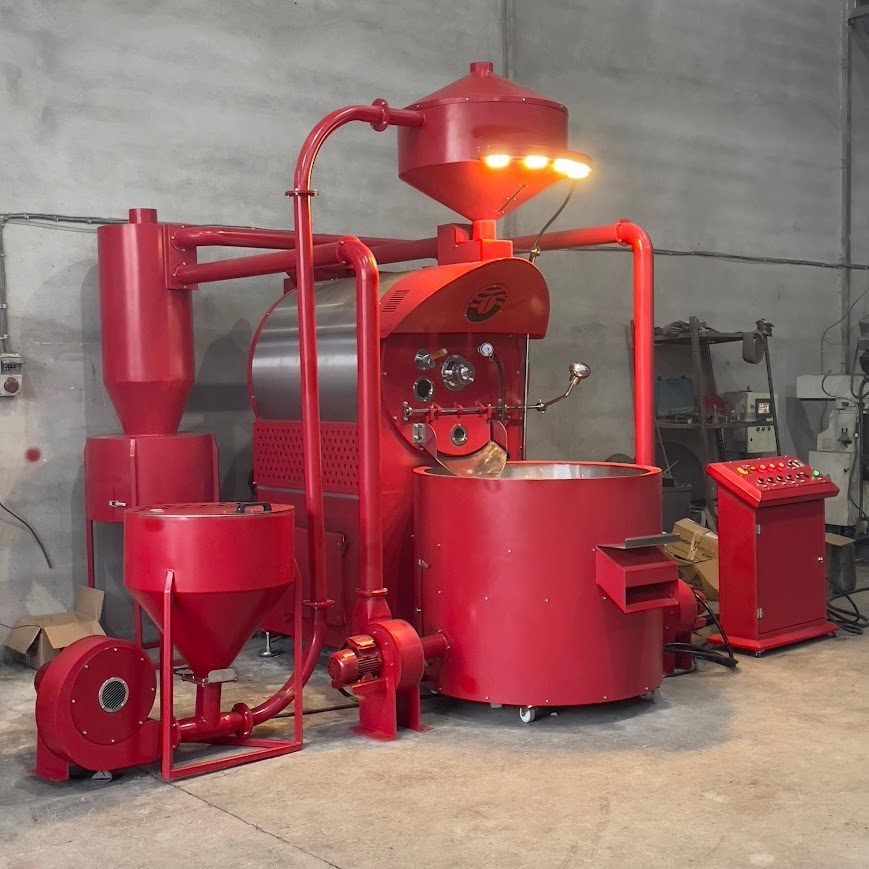
All Kafgar roasters from 15 kg (33 lb) upward are gas only. Kafgar uses Polidoro and Premix burners, and the KR-500 has a fully modulated Premix burner covering its 290 to 600 kW range.
From kilowatts to gas flow
Your installer converts kilowatts into a gas flow using the heating value of the gas actually delivered at your site, which the utility or gas supplier publishes. Natural gas carries roughly 10 kWh of energy per cubic meter, with real values varying by country and source. On that basis a KR-60 at full fire draws in the order of 9 to 10 cubic meters of natural gas per hour.
That is a peak design figure, not a consumption figure. A modulating burner spends much of each roast below full fire, and real use depends on batch size, profile, roast degree and how many batches run back to back. Size the pipe for the peak. Estimate running use from trial roasts on your own coffee.
Add up the connected load
Make a list of every gas appliance on the site and its rated input:
- The roaster or roasters.
- A gas-fired afterburner, which fires for as long as the roaster runs.
- A sample roaster in the QC lab, if it is gas fired.
- Space heating, hot water or any other gas equipment in the building.
The line is sized for everything that can run at the same time. Then add what you plan next. If a second roaster is likely within a few years, a larger main pipe now costs far less than digging up the floor later.
Natural gas, LPG or LNG
Natural gas from the public network is the simplest supply where it exists. The utility installs or upgrades the service connection and the meter for your load. Apply early, because the utility sets its own schedule and may need to reinforce the connection for an industrial load.
LPG is delivered and stored on site. Cylinders work for small shop roasters. At industrial loads, a set of cylinders often cannot turn liquid into gas fast enough. Pressure drops, the cylinders frost over and the burner loses power in the middle of a roast. Larger sites use a bulk tank, sometimes with a vaporizer, sized by the gas supplier for your peak load and refill interval. Local rules set where a tank may stand in relation to buildings, boundaries and drains.
LNG suits sites far from a pipeline that still need a large, steady supply. It arrives by truck as a liquid, is stored in an insulated tank, then vaporized and regulated on site. The system is specialist equipment, normally designed, supplied and serviced by the LNG supplier.
Pressure regulation and the gas train
The burner needs gas at a stable inlet pressure within the range Kafgar specifies for your model and gas type. Supply pressure is brought down in stages: a regulator at the meter or tank, then a final regulator close to the roaster. Between them the installer fits a manual isolation valve, a filter and a pressure gauge, and the roaster's own gas controls follow after that.
The common mistake is to test only static pressure. A long or undersized pipe holds pressure with the burner off and drops below the required range when the roaster and the afterburner fire together. Ask the installer to measure inlet pressure at the roaster with both running at full fire. That is the condition the line has to meet.
Working with a licensed installer
Gas work is regulated almost everywhere, and the person who designs and connects the line must hold the local license. Give the installer:
- The model, its heat power and the gas type.
- The required inlet pressure range, from Kafgar.
- The afterburner and every other appliance on the line.
- The building plan with the roaster position and the route from meter or tank.
- Any equipment you plan to add.
In return you should receive a design, a pressure test record and the approval or sign-off your gas authority requires before commissioning.
Tell Kafgar your gas type before the roaster is built. The burner, its nozzles and settings are matched to that gas in the factory. A later change of gas type is a burner conversion. It has to be agreed with Kafgar, done by a qualified technician and approved locally.
What CE marking covers
Kafgar gas roasters are CE marked under the EU Gas Appliances Regulation (EU) 2016/426. That covers the appliance as built. It does not replace the local rules for the installation, so the line, the ventilation and the connection are still inspected where you are. If you are still choosing between heat sources for a smaller machine, see gas or electric coffee roaster.
Frequently asked questions
Does the afterburner need its own gas supply?
It is normally fed from the same gas system, with its own isolation valve and regulator. Its input has to be part of the connected load, because it fires for the whole roasting day.
What happens if gas pressure drops during a roast?
The burner loses power first, and the roast stalls or runs slow. If the flame becomes unstable, the burner's safety controls close the gas and the batch is usually lost. Repeated drops mean the line, regulator or LPG supply is undersized for the load.
Can two roasters share one gas line?
Yes, if the main pipe is sized for both at full fire and each roaster has its own isolation valve and final regulator.
Is the gas line part of the Kafgar delivery?
The roaster arrives with its burner and safety system. The supply line up to the roaster is built locally by a licensed installer, because it has to meet local rules and be approved there.
Planning gas for your plant with Kafgar
Send us your gas type, the supply available at the site and the equipment you plan, and we will give your installer the heat power and inlet pressure figures for each machine. Compare models on the industrial type coffee roasters page, or start with the KR-60.
Request a quote on WhatsApp or by email at [email protected].