What a coffee roasting plant feasibility study must cover
What a coffee roasting plant feasibility study must cover: product mix, tonnes per year, equipment, utilities, building, staff, permits and phasing.
Short answer: A coffee roasting plant feasibility study turns a sales plan into a plant that can be built and run. It covers the market and product mix, output in tonnes per year, the equipment list, gas and power, the building, staffing, permits, logistics and phasing. Every estimate needs a stated source so a lender, partner or supplier can check it.
Lenders and partners seldom question the coffee itself. They push back when a number is missing. Nobody confirmed the gas supply at the site, nobody checked whether the floor can carry a machine weighing several tonnes, or the sales forecast cannot be traced to a single customer. A feasibility study exists to close those gaps before money is committed.
The study does not have to be long. It has to be specific, with each assumption written down where someone can challenge it.
Market and product mix come first
Everything downstream depends on what the plant will sell, so break the forecast into products rather than one volume figure. Whole bean or ground. Filter grind or very fine Turkish grind. Retail packs, or bulk bags for cafés and offices. Your own brand, or private label for retailers. A plant that sells mostly ground coffee in small packs needs far more grinding and packing capacity than one that ships whole bean in 1 kg bags.
Estimate each product line from evidence you can show: current sales if the business already roasts or imports, letters of intent from distributors or retail chains, private label contracts, and the realistic size of the channels you can reach. Build three cases (conservative, expected and strong) and carry all three through the study. If the plant only works in the strong case, treat that as a warning.
Turn sales into tonnes per year
Sales forecasts are written in roasted coffee. Plants are sized in green coffee. Roasting drives off moisture and some organic matter, so the drum loses roughly 12 to 20 percent of the green weight depending on roast degree and bean moisture. To sell 500 tonnes of roasted coffee a year at 15 percent loss, the plant has to buy and roast about 588 tonnes of green coffee.
Then look at the calendar. Many markets have seasonal peaks, and private label orders tend to arrive in large blocks. Size the plant for the busiest months, not the annual average. The capacity section should show the full calculation: rated hourly output of the roaster, productive roasting hours per shift, shifts per day, working days per year and an allowance for downtime.
The equipment list follows the capacity figure
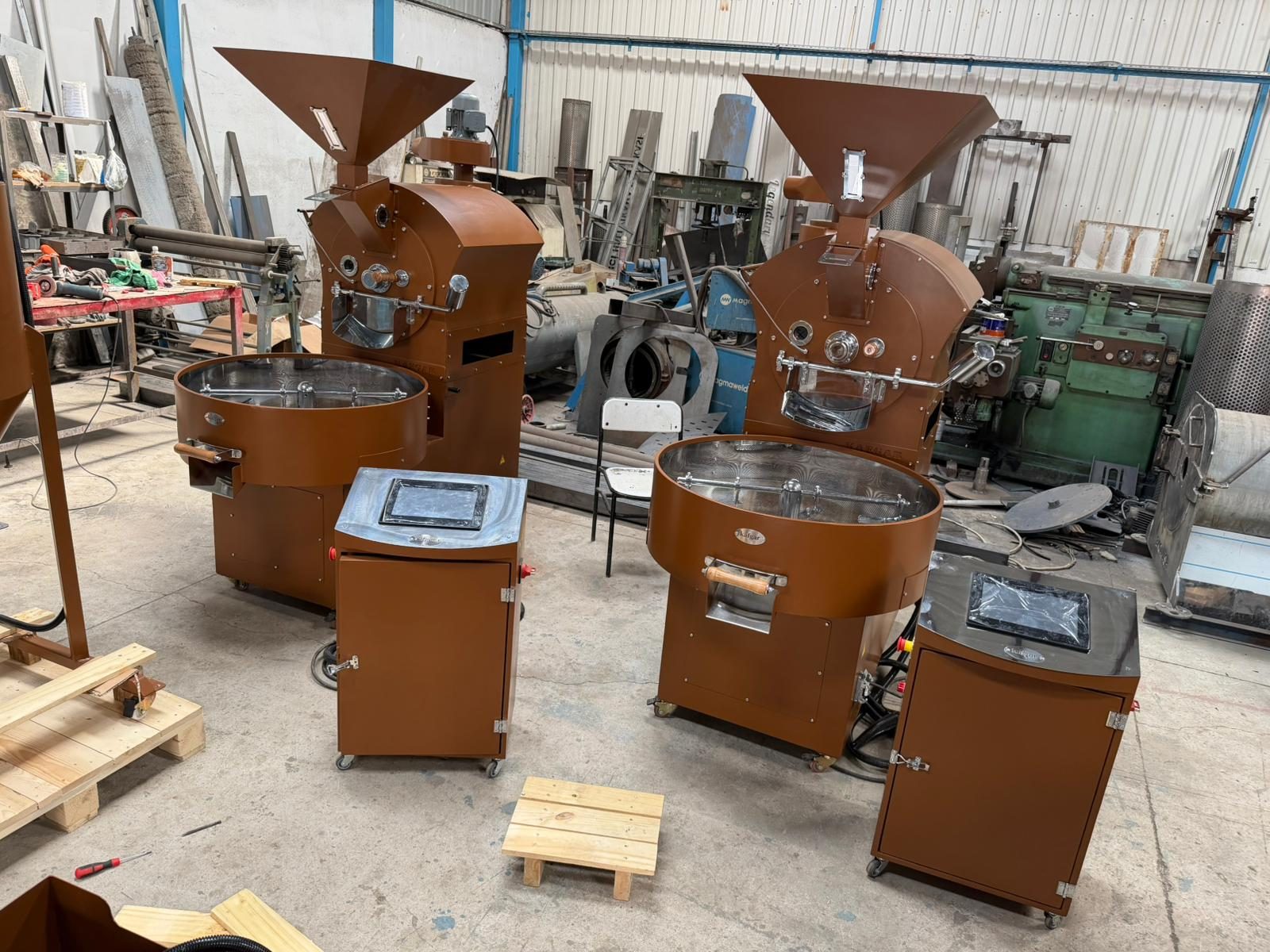
Once the capacity figure is fixed, the equipment list can be drawn up line by line: green intake and loading, destoner, roaster with cooling, afterburner where needed, blending, roasted coffee storage, grinding and packing. The overview of what a complete coffee roasting plant needs works as a checklist. For each item, record the model, its rated output and who manufactures or supplies it.
Then check that every machine keeps pace with the roaster for the product you actually sell. The KM-300 grinds 250 kg per hour of filter coffee but 150 kg per hour of Turkish coffee, so a product mix that shifts toward fine grind can turn the grinder into the bottleneck.
Utilities decide the site
Ask the utility questions early and get the answers in writing.
- Gas: which gas the site can get (natural gas from a grid, LNG, or LPG from cylinders or a bulk tank), at what supply pressure, and whether the supplier can deliver the volume year round. Kafgar roasters of 15 kg (33 lb) and larger are gas fired, and the gas installer sizes the line for the burner's heat power: 93 kW for a KR-60, 140 kW for a KR-120 or KR-240, and 290 to 600 kW for a KR-500.
- Electricity: three-phase supply, voltage, frequency, and the total connected load including roasters, grinders, conveyors, packaging machines and lighting. Kafgar industrial roasters run on 380 V as standard.
- Water and drainage for cleaning, the quality lab and staff areas.
- Compressed air, if the packaging machines need it.
A site without a gas connection is not ruled out. The study then has to show how fuel will be delivered and stored, and who approves the installation.
Building, floor and exhaust route
Record floor area, clear ceiling height, door sizes, column positions and the rated floor load. Industrial roasters are heavy: a KR-60 weighs 1,800 kg, a KR-120 3,200 kg and a KR-240 5,000 kg. Green coffee stock adds a large load of its own. If the building is rented, confirm that the lease allows the works, a gas installation and an exhaust stack.
The exhaust route deserves its own line. The roaster duct has to reach the outside by a sensible path, and the neighbors matter as much as the rules. A building close to homes may need an afterburner and careful stack placement even where the regulations would allow less.
Staffing and skills
List the roles per shift: roaster operators, a quality person for cupping and color checks, packing staff, a warehouse role for intake and dispatch, and maintenance. Then note where each skill will come from. Operators can be trained during commissioning, but a plant with nobody who can read a roast curve or adjust a grinder will lean on outside help for longer than planned.
Permits and approvals
Requirements differ by country and by site, so the study should name the authorities instead of guessing at their rules. In most places the list includes land use or zoning for food production, an environmental or air quality permit for the roasting exhaust, approval of the gas installation, fire safety and food business registration. Find out which approvals must be granted before construction starts and which can follow. That sequence often sets the real start date.
Logistics in and out
Green coffee usually arrives by container. State how many weeks of green stock the plant will hold and where it will sit (the post on green coffee silos and storage planning covers the options). For outbound, estimate pallets of finished goods per week, distances, and own vehicles or a carrier. Plan the machine delivery too. From the KR-120 up, roasters travel without a crate, directly in the container, so the site needs room for a container truck and lifting equipment of the right capacity.
Phasing keeps the first step realistic
Few plants need full capacity on day one. A common first phase is one roaster, a loader, a destoner, an afterburner and one grinder. A second phase adds a roaster, silos, a mixer or more packing. Show both phases on one layout so the first leaves floor space and utility capacity for the second. Sizing the gas line and the main electrical panel for phase two at the start is far simpler than reopening them later.
What to estimate, section by section
| Section | What to estimate | Typical source |
|---|---|---|
| Market | Volume by product, in three cases | Sales history, letters of intent, channel data |
| Capacity | Green coffee in tonnes per year and per peak month | Sales forecast, roast loss of 12 to 20 percent |
| Equipment | Models, rated outputs, scope | Supplier layout and quotation |
| Utilities | Gas type and supply, electrical load | Utility providers, installers, data sheets |
| Building | Area, height, floor load, exhaust route | Building survey, structural engineer |
| Staffing | Roles per shift, training | Production plan |
| Permits | Authorities and their sequence | Local consultant, authorities |
| Logistics | Weeks of green stock, outbound pallets | Purchasing plan, carriers |
| Phasing | What is built now and what later | One layout showing both phases |
Each row also carries a cost line in the financial model. A firm equipment quotation does not make up for a guessed utility answer.
Frequently asked questions
Who should prepare a roasting plant feasibility study?
The investor or owner usually leads it. An equipment supplier provides capacity, layout and utility data, a local engineer covers the building, and a consultant who knows the local permit process covers approvals. Lenders often prefer a market section prepared independently of the supplier.
Can an equipment supplier's investment estimate replace the study?
No, but it feeds the study. A supplier can give a reliable equipment list, layout and utility loads. The market, permit, staffing and financing assumptions remain the investor's work.
How detailed should the equipment section be at this stage?
Detailed enough to fix utility loads, floor area and weights. Model names, rated outputs, heat power, electrical requirement, dimensions and weight from the data sheets are usually enough.
What if demand turns out lower than the expected case?
That is what the conservative case and the phasing plan are for. If the first phase works at conservative volume, the second roaster can wait until demand is proven.
Getting plant data for your study
For roasting plant projects, Kafgar prepares an equipment list, a layout and, on request, a free investment estimate from the target output, product mix, building data and country you send. The turnkey coffee roasting plants page and the industrial roasters data sheets give the heat power, electrical load, dimensions and weights your engineers will ask for first.
Request a quote on WhatsApp or by email at [email protected].