Industrial coffee grinder sizing for a packing line
Match an industrial coffee grinder to roaster and packing line: throughput by grind, disc vs roller mills, heat in long runs, filter and Turkish grind.
Short answer: Size an industrial coffee grinder from the roasted output it must handle, at the finest grind you sell. Turkish grind runs well below filter grind on the same machine, for example 150 against 250 kg per hour on a KM-300. For long runs into a packer, a water-cooled grinder keeps grind temperature and particle size steady.
In many ground coffee lines the grinder is picked last, from a catalog, as if it were a separate machine. It is one stage of a line whose speed is set by the roaster on one side and the packer on the other, and it is often the stage that limits output.
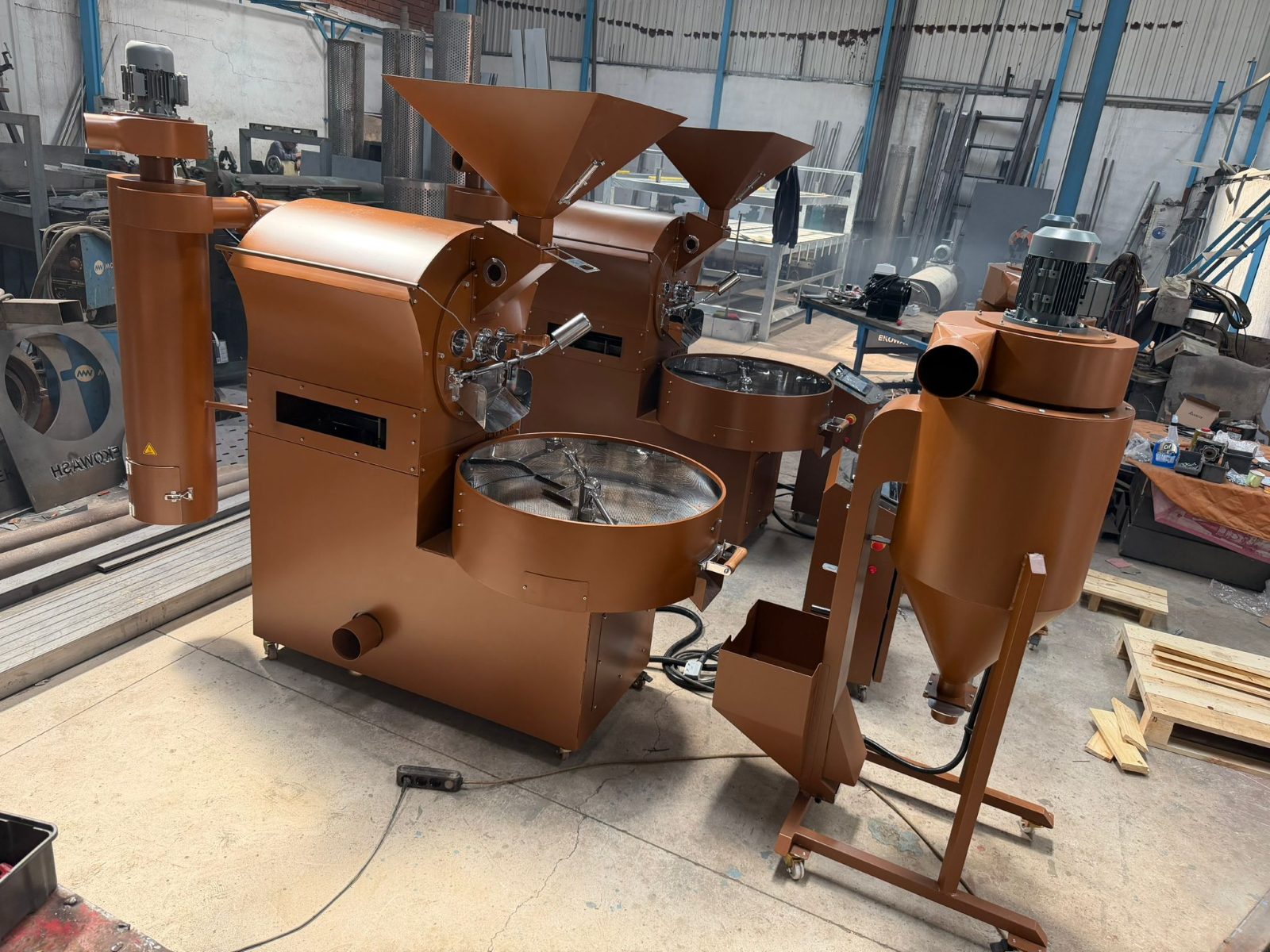
Take a KR-60. It roasts up to 180 kg of green coffee per hour, so after a roast loss of roughly 12 to 20 percent, about 144 to 158 kg of roasted coffee leaves the cooler every hour. If the plant sells all of it as ground coffee, the grinder has to keep pace at whatever setting is on the schedule. A grinder rated at 110 kg per hour for filter grind cannot, however good its discs are.
Start from the grind, not the motor
Grinder output is not one number. The finer the grind, the more work each kilogram needs and the slower it passes between the discs. The rated figures for the Kafgar KM grinders show the gap.
| Model | Turkish grind (kg per hour) | Filter grind (kg per hour) | Motor (kW) | Discs (mm) | Cooling |
|---|---|---|---|---|---|
| KM-200 | 70 | 110 | 4 | 200 | No water cooling |
| KM-300 | 150 | 250 | 11 | 300 | No water cooling |
| KM-300W | 140 to 180 | 250 to 400 | 15 | 300 | Water, integrated chiller group |
All three use discs in 4140 alloy steel. The KM-200 and KM-300 discs are hardened to 50 to 55 HRC, the KM-300W discs to 52 to 55 HRC.
Run the numbers for your own product mix. Take the KR-60 example again:
- All filter grind, about 144 to 158 kg per hour: a KM-300 covers it with room to spare. A KM-200 does not.
- All Turkish grind: a KM-300, rated at 150 kg per hour, is at or just past its limit with no margin for a slow hour. A KM-300W, rated at 140 to 180 kg per hour, is the closer fit and stays cool over the run, but confirm its output on your coffee in a trial.
- Half whole bean, half ground: the grinder only sees half the roasted output, and a smaller machine may fit.
For a KR-120, which roasts up to 360 kg of green coffee per hour, the roasted output is roughly 288 to 317 kg per hour. That is beyond a single KM-300 at filter grind, within the KM-300W filter range, and needs at least two KM-300W grinders if it all goes out as Turkish coffee.
Disc mills and roller mills in plain terms
A disc grinder has two flat, toothed discs, one fixed and one turning. Coffee enters at the center and is cut as it moves outward through the narrowing gap. Moving one disc closer sets a finer grind. Disc grinders cover the whole range from coarse filter to powder-fine Turkish coffee on one machine, which suits plants with several products. Kafgar KM grinders are disc grinders.
A roller mill passes the coffee through pairs of grooved rollers in stages, each pair a little closer than the one before. The staged cutting gives a narrow particle size spread with less heat. Roller mills are common in very large ground coffee plants that run long campaigns of one filter or espresso grind. They are larger, and changing between very different grinds takes more adjustment.
For most roasting plants that pack several products, including Turkish coffee, disc grinders are the practical choice. A plant that grinds a single filter product around the clock at very high volume is where roller mills come into the discussion.
Heat over a long run
Every cut creates friction, and friction turns into heat in the discs, the grinding chamber and the coffee. At a fine setting and full output the heat builds faster. Warm grinding drives off aroma, and warm ground coffee packed straight away keeps releasing aroma and gas inside the pack. As the discs warm, the grind can also drift, so the last hour of a shift does not match the first.
Air-cooled grinders handle this well when they run in blocks with pauses, or below their rated output. For a packing line that runs for hours without stopping, water cooling is the more reliable answer. On the KM-300W, cold water runs through both grinding discs and an integrated chiller group (4 HP, with a 6 HP option) keeps the grind temperature stable, so the ground coffee can go straight to the packaging line. The case for water cooling is set out in more detail in why water-cooled grinders win at high volume.
Filter and Turkish settings on one line
Filter coffee needs a medium grind with an even spread of particles and few fines. Turkish coffee needs the finest grind in everyday coffee, close to flour. A line that produces both should plan for:
- A changeover routine: purge the grinder with the new product and discard or rework the first output until the grind is on target.
- A simple check at each changeover, such as a sieve test or a reference sample, recorded with the batch.
- Scheduling that groups products by grind, so the machine is not moved back and forth all day.
- Capacity calculated at the Turkish figure for the hours that product runs, not at the filter figure.
The grind itself for Turkish coffee is covered in grinding for Turkish coffee the right way.
Feeding and protecting the grinder
Much of the disc damage in plants comes from what arrives with the coffee: a stone that survived the green coffee cleaning, a nail from a sack, a bolt from a conveyor. A destoner between the cooler and the roasted coffee storage, plus a magnet in the grinder feed, protects the discs and the motor. Kafgar manufactures destoners as part of the plant line.
Feed the grinder from a hopper or silo that holds enough coffee to keep it running steadily. The KM-300W has a 40 kg hopper. A screw elevator or conveyor that keeps the hopper topped up avoids the stop and start pattern that makes grind size drift. On the outlet side, a small buffer between grinder and packer lets each machine run at its own rhythm without one stopping the other.
Ground coffee releases CO2 quickly. Plan a short, closed buffer before packing where the pack format needs it, and keep that buffer small, because ground coffee also loses aroma fast.
Frequently asked questions
How often do grinding discs need replacing?
It depends on tonnage, grind setting, roast degree and how clean the incoming coffee is. Fine Turkish grinding and any stones or metal in the feed shorten disc life. Track the grind size and output at a fixed setting, and plan a disc change when they start to drift.
Can one grinder serve two roasters?
Yes, if its output at the finest grind covers the combined roasted output for the hours that product runs. Add roasted coffee storage between the roasters and the grinder, so both roasters can discharge while the grinder works at a steady rate.
Does water cooling change the grind size?
It keeps the grind size more stable over a long run. Without cooling, the discs and chamber warm up and the grind can drift during the shift. With water running through both discs, the setting you choose at the start stays closer to target.
What electrical supply does a KM grinder need?
The motors are 4 kW on the KM-200, 11 kW on the KM-300 and 15 kW on the KM-300W, plus the chiller group on the water-cooled model. Confirm the voltage and supply with us when you order, so the machine is wired for your site.
Matching the grinder to your line
Kafgar manufactures the KM-300, the KM-200 and the water-cooled KM-300W, and sizes them against the roaster and the packer in each plant project. A grinder proposal needs three figures from you: roaster size, product mix and the split between Turkish and filter grind.
Request a quote on WhatsApp or by email at [email protected].