Turkish Coffee Production: Planning the Line From Roaster to Pack
Turkish coffee production from green bean to pack: roast degree, cooling, destoning, very fine grinding capacity, small pack filling and powder freshness.
Short answer: A Turkish coffee production line roasts to an even, light-medium degree, cools fast, removes stones, then grinds to a powder in disc grinders sized at their Turkish grind figure, which is well below their filter output. The powder is packed in small barrier packs soon after grinding, because very fine coffee loses aroma quickly.
Turkish coffee is brewed with the grounds in the pot and served with them in the cup. Nothing filters out a defect. A scorched bean, a bitter dark note or a gritty, uneven powder reaches the customer directly, and it does so in a product that most people buy already ground. That makes Turkish coffee a demanding product for a plant, even though the recipe looks simple, and several stages of the line need different settings or equipment than a filter or whole bean line.
Stage by stage
1. Green coffee and blend
Turkish coffee is usually sold as a stable blend that tastes the same from one pack to the next for years. That puts the weight on green coffee intake: consistent lots, sample roasting and cupping before a lot enters production, and enough storage to bridge from one shipment to the next. A sample roaster in the plant's lab lets the team check each lot against the reference before it is blended.
2. Roasting
The roast degree for Turkish coffee is typically light-medium to medium, with a dry, matte surface. A dark, oily roast is a poor fit. Oil on the bean surface smears the grinding discs, makes the powder clump and adds bitterness that the brewing method, with its long contact between coffee and water, makes more obvious.
Evenness matters more than the exact degree. In a whole bean pack, a few lighter or darker beans pass unnoticed. Ground to powder, they shift the color and taste of the whole batch. A drum roaster with steady airflow, controlled drum speed and recorded profiles gives that evenness batch after batch. Kafgar roasters use PLC control with drum speed control and are compatible with Artisan and Cropster for logging each batch.
3. Cooling and destoning
Fast cooling stops the roast at the degree you chose. Kafgar roasters cool in an air-vacuum cooling chamber or tray, which brings the beans down to handling temperature quickly.
After cooling, the beans pass a destoner. In a Turkish coffee line this step is not optional. The grinder runs with its discs very close together, and a single stone at that gap can damage both discs. A destoner removes stones and heavy foreign matter by density before the coffee reaches roasted storage.
4. Resting and blending
Some plants blend after roasting, using a mixer to combine components roasted separately. The roasted coffee then rests in storage before grinding, long enough to settle and degas a little, short enough to stay fresh. Roasted coffee silos are supplied as part of a project, while Kafgar manufactures the mixers, conveyors and elevators that move the coffee between them.
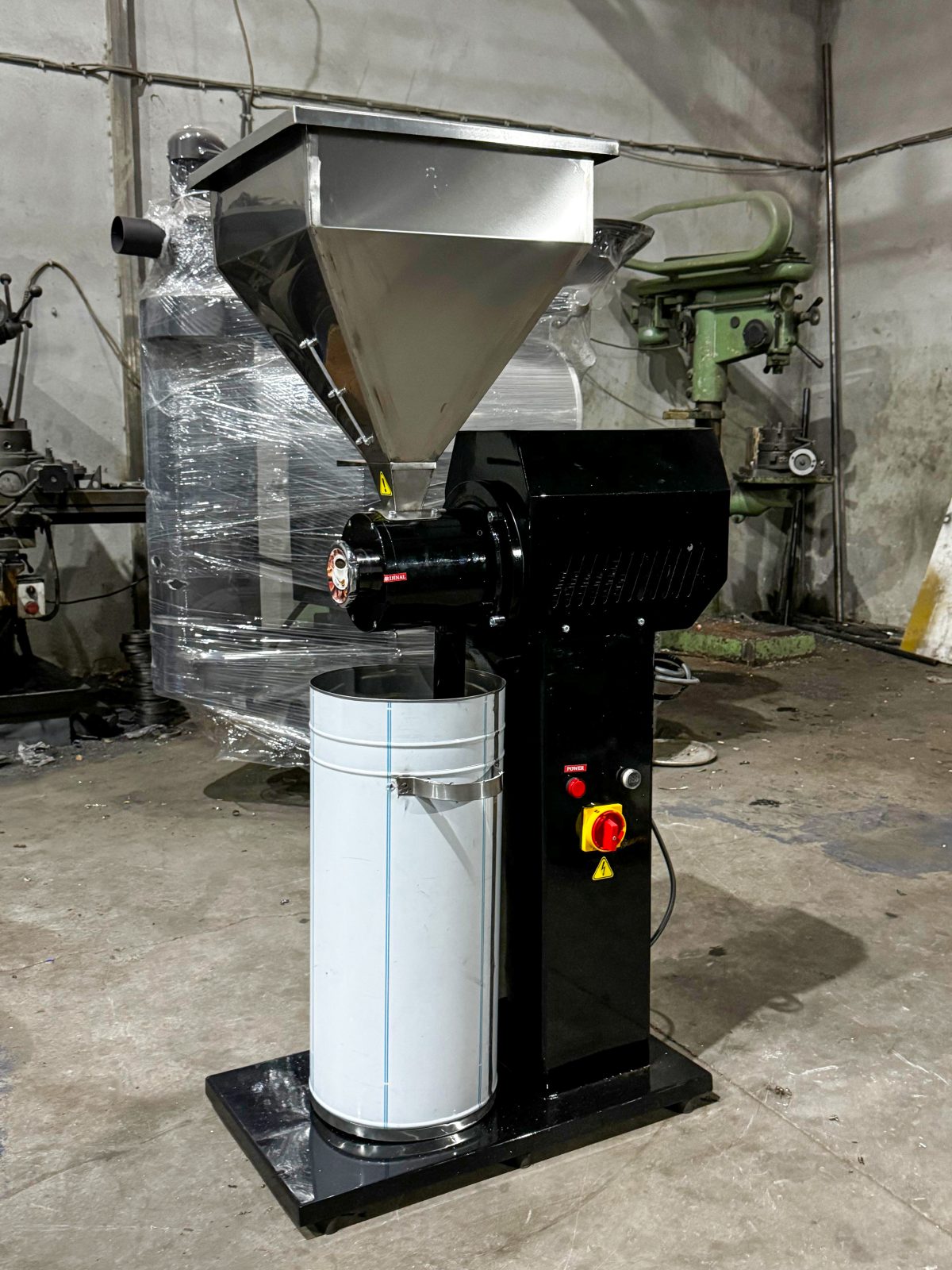
5. Grinding
This is where most Turkish coffee lines are undersized. The powder-fine setting needs far more work per kilogram than filter grind, and the output drops accordingly. Size the grinder at its Turkish figure:
- KM-200: 70 kg per hour Turkish grind, against 110 kg per hour filter grind.
- KM-300: 150 kg per hour Turkish grind, against 250 kg per hour filter grind.
- KM-300W (water-cooled): 140 to 180 kg per hour Turkish grind, against 250 to 400 kg per hour filter grind.
Fine grinding also creates the most friction and heat. On a line that grinds Turkish coffee for hours at a time, the water-cooled KM-300W keeps the discs and the powder at a stable temperature, so the grind does not drift and the coffee can go straight to the packer. The grind itself, and why it must be even at that fineness, is covered in grinding for Turkish coffee the right way.
6. Packing
Turkish coffee is mostly sold in small packs, so a household opens a fresh pack often instead of keeping a large one open for weeks. Packs are usually laminated barrier films, often with foil, and many producers vacuum pack or flush them with nitrogen. Very fine powder flows differently from beans, so ground coffee packers use auger or precision weighing systems designed for powder. Kafgar supplies powder coffee packagers for this stage, it does not manufacture them.
Keep the time between grinder and packer short. A small hopper or closed buffer between the two is enough. Ground Turkish coffee left in open bins loses noticeable aroma within hours.
Matching roaster and grinder
The table below pairs Kafgar roasters with grinders for a line where all roasted coffee leaves as Turkish grind. Roasted output is calculated from the roaster's hourly green capacity with an assumed roast loss of 15 percent, a reasonable figure for a light-medium roast. Your own roast loss and grind setting will move these figures, so treat them as a starting point.
| Roaster | Batch | Green coffee (kg per hour) | Roasted coffee, approx. (kg per hour) | Grinder for all-Turkish output |
|---|---|---|---|---|
| KR-20 | 20 kg (44 lb) | 60 | 51 | One KM-200 |
| KR-30 | 30 kg (66 lb) | 90 | 77 | One KM-300 |
| KR-60 | 60 kg (132 lb) | 180 | 153 | One KM-300W |
| KR-120 | 120 kg (265 lb) | 360 | 306 | Two KM-300W |
The KR-30 line shows why the Turkish figure matters. Its roasted output would fit a KM-200 at filter grind, but at Turkish grind it needs the larger KM-300. In the KR-60 line, 153 kg per hour is already above the KM-300's Turkish figure and inside the KM-300W's 140 to 180 kg range. If the grind setting puts the KM-300W near the low end of that range, plan slightly longer grinding hours than roasting hours.
If the plant also sells whole beans or filter grind, the grinder sees only the Turkish share, and a smaller configuration may fit. Planning roaster and grinder together, as part of one coffee roasting plant, avoids a line where one machine waits for the other.
Keeping the powder fresh
Freshness in Turkish coffee is decided in the last hour before the pack is sealed and in the first days after the customer opens it. A few practices make the biggest difference:
- Grind to the packing schedule, not ahead of it.
- Keep powder covered and cool between grinder and packer.
- Choose a pack size that a household finishes quickly.
- Print a roast or production date the customer can read.
- Store finished packs away from heat and sunlight in the warehouse.
Frequently asked questions
Can the same grinder produce Turkish and filter coffee?
Yes. KM grinders adjust from filter grind down to Turkish powder. Plan a changeover routine, group products by grind on the schedule, and check the grind after each change before packing starts.
Is a water-cooled grinder needed for a small Turkish coffee line?
Not always. A KM-200 or KM-300 handles Turkish grind well when it runs in blocks with breaks or below its rated output. Water cooling pays off when the grinder runs Turkish coffee for many hours without stopping.
Can cardamom or other flavors be added on the same line?
Flavored Turkish coffee is common in some markets, and spices are usually blended with the ground coffee before packing. Plan a separate mixer or a strict cleaning routine, because spice aroma carries over into plain coffee very easily.
Does Turkish coffee need a degassing valve on the pack?
Small vacuum or nitrogen flushed packs of ground coffee are often sealed without a valve after a short rest. Whether your pack needs one depends on the format, the rest time and the film, so test packs before production.
Building a Turkish coffee line with Kafgar
Kafgar builds its machines in Türkiye, where Turkish coffee is part of daily life, and ships them to 50+ countries. We manufacture the roasters, KM grinders including the water-cooled KM-300W, destoners and conveying equipment, and supply the packing machines and silos as part of the project. Send us your target output and the share of Turkish grind in your product mix, and we will suggest a line.
Request a quote on WhatsApp or by email at [email protected].