How a coffee roaster cyclone separates chaff, and why it sometimes fails
How a coffee roaster cyclone separates chaff from exhaust air, why chaff escapes, how to empty and clean it, and its link to fire risk and the afterburner.
Short answer: A coffee roaster cyclone spins the exhaust air inside a cone so that chaff is thrown against the wall and falls into a collection bin, while cleaner air leaves through the top. It works only with the right airflow, a sealed bin and regular emptying. Chaff that escapes ends up in ducts, on the roof or in the afterburner.
Light brown flakes on the roof next to a roastery stack, or drifting into a neighbor's yard, are chaff the cyclone did not catch. Most of the time the cyclone itself is fine. The cause is usually a full bin, a leaking seal or airflow that has changed since the machine was installed.
Chaff is the thin silver skin that clings to green coffee and comes loose as the beans expand during roasting. It is light, dry and burns easily. Every batch produces it, and every gram has to go somewhere.
What happens inside the cone
The roaster's exhaust fan pulls air out of the drum, carrying smoke, moisture and chaff. That air enters the upper part of the cyclone through an inlet set to one side of the round body, so it starts to spin along the wall instead of flowing straight through.
As the air spirals down into the narrowing cone, it speeds up. Chaff and dust are much heavier than the air around them, so the spinning motion throws them outward against the steel wall. There they lose speed, slide down and drop out through the bottom of the cone into a bin or drawer.
Near the bottom, the air turns and rises up through the center of the cyclone in a narrower inner vortex, then leaves through a central outlet pipe at the top. From there it goes to the stack, or first through an afterburner.
There is no filter to clog and no moving part inside. That is why cyclones are standard on most drum roasters. It is also why their performance depends almost entirely on airflow and on how well the system is sealed.
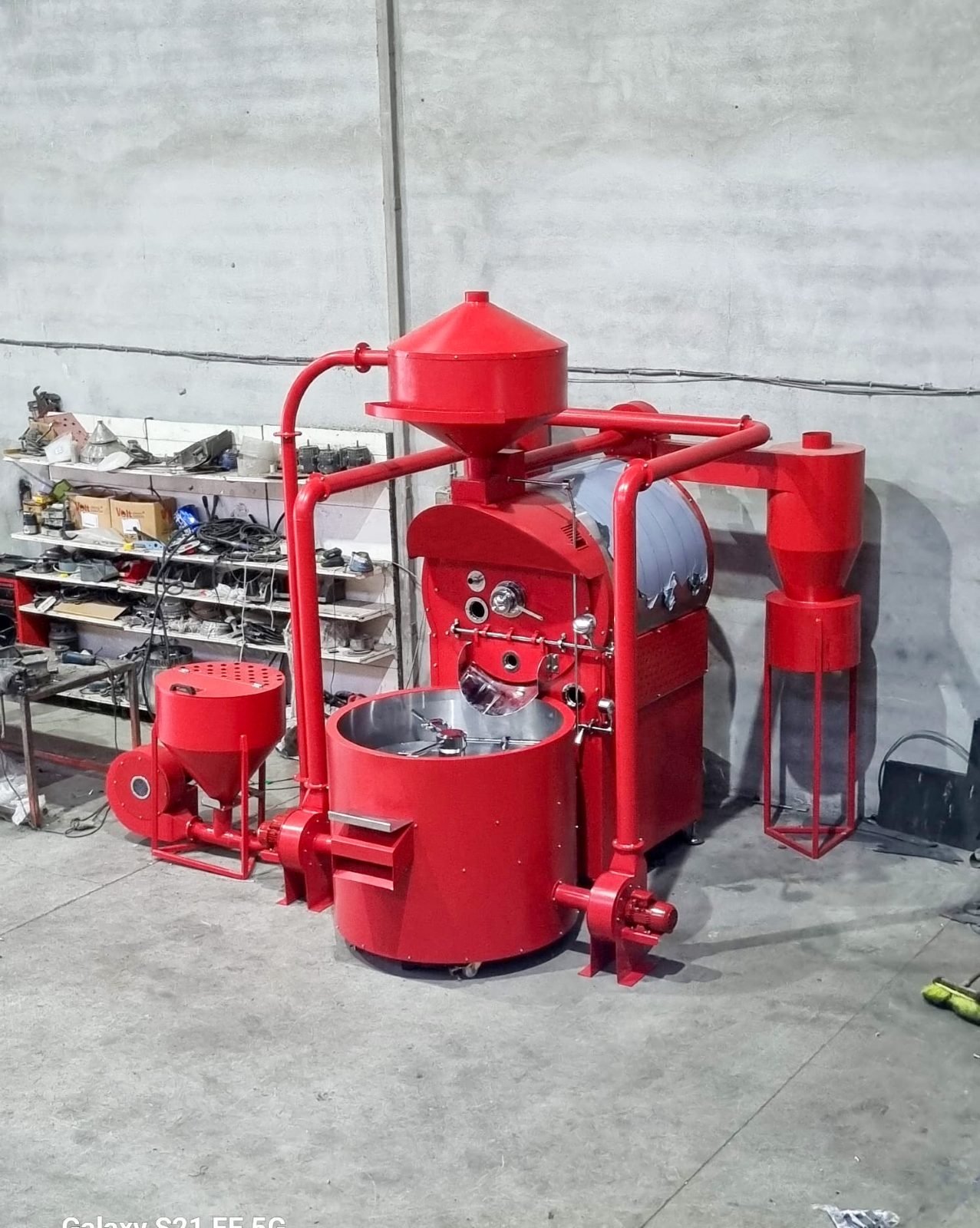
Roasting cyclone and cooling cyclone
A drum roaster has two separate air streams, and larger machines often have a cyclone on each.
The roasting cyclone sits on the drum exhaust. It handles hot air loaded with smoke, oils and most of the chaff. This is the cyclone with the higher fire risk, because the chaff in it is hot and the walls collect oily residue.
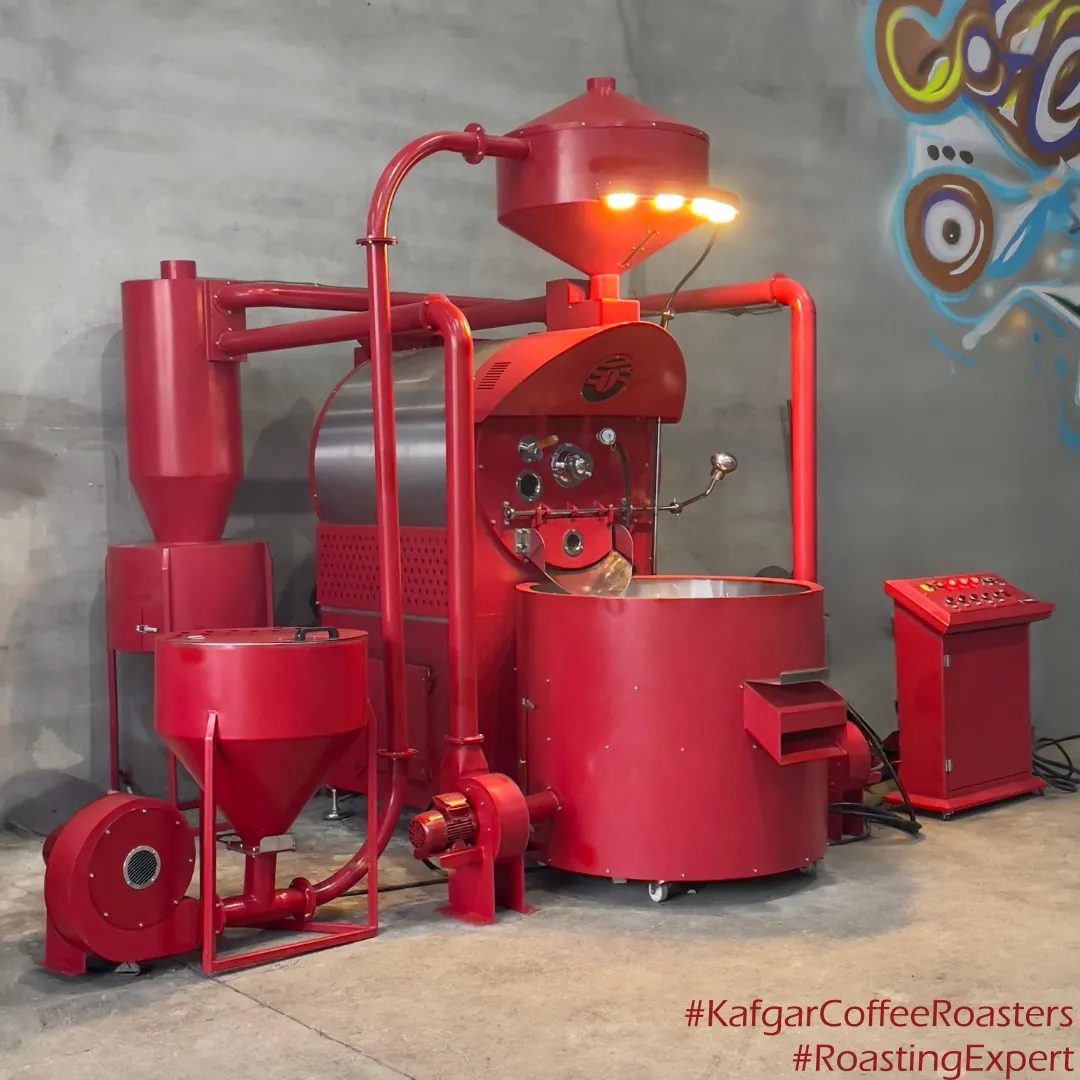
The cooling cyclone sits on the air drawn through the cooling tray. That air is cooler but still carries chaff and fine dust shaken loose as the stirring arms turn the beans. Kafgar roasters use an air-vacuum cooling chamber that draws room air through the beans, so that stream needs its own separation before it is released.
Keeping the two streams apart matters. Cooling air is not usually routed through the afterburner, and mixing cold cooling air into the hot roasting exhaust can disturb the afterburner and the roaster's airflow balance. The KR-500 has an external cyclone chaff collector in its design.
Why chaff gets past the cyclone
| Symptom | Likely cause | What to check |
|---|---|---|
| Chaff blowing from the stack | Bin full, chaff carried back up the center | Empty the bin, review the emptying schedule |
| Chaff blowing from the stack, bin not full | Air leak at the bin seal or the cone outlet | Gasket, clamps, bin seating |
| Weak suction at the drum, smoke at the door | Cyclone or ducts partly blocked | Inlet, cone wall and duct bends for buildup |
| Chaff in the cooling tray area | Cooling cyclone full or cooling fan airflow too high | Cooling bin, fan setting, damper |
| Chaff collecting in the afterburner | Cyclone efficiency dropped | All the above, then the inlet shape |
| Oily black layer inside the cone | Normal residue, but thick buildup slows the spin | Cleaning interval |
The most frequent cause is also the simplest. A cyclone with a full bin cannot drop chaff out of the cone, so the inner vortex picks it up and carries it out of the top.
Leaks come next. A cyclone runs under suction, and any gap at the bin lets outside air rush in at the bottom, exactly where chaff should be falling out. That incoming air lifts the chaff and sends it up the center.
Airflow outside the design range causes the rest. Too little air and the spin is too weak to separate the lighter chaff. Too much and the air can carry chaff through before it settles. For how airflow shapes the roast itself, see the role of airflow in coffee roasting.
Emptying and cleaning
The emptying interval depends on the batch size and the coffee. Some coffees shed far more chaff than others, and dark roasts leave more oily residue. A practical rule is to set the interval by checking the bin at the end of each batch for the first weeks on a new coffee, then fix a schedule with a margin.
- Empty the chaff bin before it is half full, and always at the end of the roasting day.
- Check the bin gasket and clamps each time the bin goes back on.
- Inspect the inlet and cone wall for buildup at a fixed interval, and scrape or brush it out with the roaster cold.
- Clean the duct from the drum to the cyclone and from the cyclone to the stack, including bends, where chaff and oil collect first.
- Record each cleaning in the maintenance log next to the batch count.
Empty chaff into a closed metal container, not a plastic bag or a cardboard box. Chaff from the last batch can still be hot. The wider routine for the whole machine is in how to maintain your coffee roaster.
The link to fire risk and the afterburner
Chaff is fuel. A cyclone that has not been cleaned holds a layer of dry chaff and oily residue right next to the hottest air in the plant. If a fire starts in the drum and sparks are pulled into the exhaust, that layer is where it spreads. Regular emptying and cleaning removes most of that fuel. On the KR-500, a water-injection safety system is also part of the design.
The cyclone also protects the afterburner. An afterburner is built to burn smoke and odor compounds at high temperature, not to burn a steady stream of chaff. A cyclone that works well keeps solid particles out of it, so the afterburner can do its real job. For how the afterburner itself works, read afterburners and clean coffee roasting.
Frequently asked questions
Can a cyclone be replaced by a filter?
Filters clog quickly with oily chaff and hot exhaust, and a clogged filter chokes the roaster's airflow. The cyclone handles the bulk of the chaff without that problem, which is why it is the standard first stage on drum roaster exhaust.
Does a bigger cyclone catch more chaff?
Not automatically. A cyclone is designed for a range of airflow. If it is oversized for the fan, the air spins too slowly to separate the chaff well. The cyclone should be matched to the roaster and its fan.
Is chaff from the cyclone useful?
Many roasteries give it away as garden compost or mulch, or to farmers as animal bedding. Check that it is fully cooled before it leaves the plant.
Who sizes the cyclone and ducts for a new plant?
The roaster manufacturer sizes the cyclone to the roaster. The duct run to the outside depends on the building, so it is planned with the plant layout and checked by a qualified local contractor.
Cyclones on Kafgar roasters
Kafgar plans the roaster, its chaff separation and the afterburner as one exhaust line, so the cyclone is matched to the roaster's fan and to the afterburner downstream. The afterburner is built in the Kafgar factory. The KR-500 includes an external cyclone chaff collector. For other models, the exhaust layout is part of the plant drawing.
Request a quote on WhatsApp or by email at [email protected].