Coffee Roasting Plant Capacity, From Tonnes per Year to Machines
Coffee roasting plant capacity from tonnes per year to machine size: roasting hours, shifts, uptime and roast loss, with KR-60, KR-120 and KR-240 examples.
Short answer: To plan coffee roasting plant capacity, convert annual roasted sales into green coffee using roast loss, divide by the productive roasting hours your shifts really give you, and allow for downtime. Compare the result with the rated hourly output of each roaster. A KR-120 rated at 360 kg per hour can cover very different tonnages depending on the shift pattern.
A KR-120 is rated at 360 kg of green coffee per hour. That does not mean a plant running one eight-hour shift will roast 360 kg for every hour on the clock. Warm-up, cleaning, changeovers, maintenance and the weight the coffee loses in the drum all sit between the rating and what leaves the dispatch dock. Capacity planning puts a number on each of them.
This is a plant-level calculation. Choosing a single roaster from weekly sales is covered in how to choose the right coffee roaster capacity. Here the question is how many tonnes a year a line can deliver, and on how many shifts.
What the hourly rating means
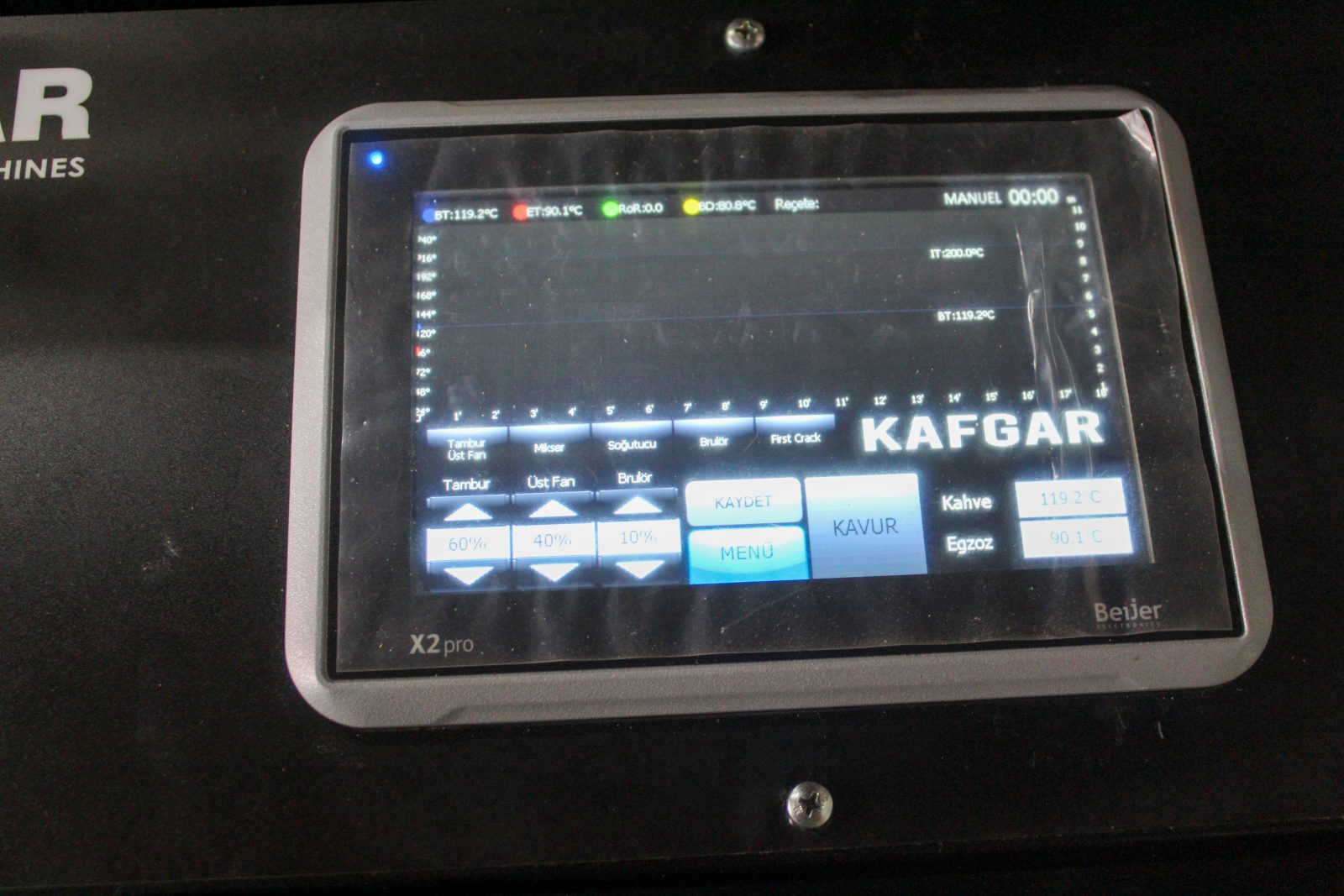
Kafgar rates its roasters in kg of green coffee per hour. The figures are simple multiples of the batch: a KR-60 roasts 60 kg (132 lb) per batch and is rated at 180 kg per hour, a KR-120 roasts 120 kg (265 lb) for 360 kg per hour, and a KR-240 roasts 240 kg (529 lb) for 720 kg per hour. That is three full batches an hour, with roast cycles of 12 to 16 minutes.
Two things pull real output below the rating. Long profiles at the 16 minute end, plus charging and dropping, can cost a batch now and then. Partial batches for small orders roast fewer kilograms in the same time. If a share of your production will run below full batch, plan with the batch size you will really use.
The calculation in five steps
- Convert sales to green coffee. Roast loss is roughly 12 to 20 percent depending on roast degree and moisture. Divide roasted tonnes by one minus the loss. At 15 percent, 600 tonnes roasted needs about 706 tonnes green.
- Count working days. Public holidays, planned shutdowns and stock counts come off the calendar. A five-day week gives 260 days before holidays, so 250 is a common planning figure.
- Count productive hours per shift. An eight-hour shift does not give eight roasting hours. The roaster needs to warm up, the chaff collector and cyclone need emptying, and changing between blends or roast degrees takes time. Seven hours of roasting per shift is a reasonable starting figure to test against your own operation.
- Apply an uptime allowance. Maintenance, unplanned stops and quality holds take a share of the remaining hours. Pick a figure, state it, and test the plan with a lower one.
- Divide and compare. Required green coffee per year divided by effective hours gives the hourly output you need. Compare it with the rated output of each model.
A worked example
Take a plant that expects to sell 600 tonnes of roasted coffee a year. Assume 15 percent roast loss, 250 working days, seven productive hours per shift and 85 percent uptime. Each shift then gives about 1,488 effective roasting hours a year (250 x 7 x 0.85), and the plant must roast about 706 tonnes of green coffee.
- On one shift, the line needs about 475 kg of green coffee per hour. A KR-120 at 360 kg per hour falls short. A KR-240 at 720 kg per hour covers it with room to spare.
- On two shifts, the requirement drops to about 237 kg per hour. A KR-120 handles it at roughly two thirds of its rating. A KR-60 at 180 kg per hour does not.
- On three shifts, the requirement is about 158 kg per hour. A KR-60 could do it, but at close to 90 percent of its rating there is little slack for a peak month, and no shift left for maintenance.
The same tonnage can be met by a large machine on one shift or a smaller one on three. The choice depends on labor, the cost and availability of night work, how much growth the plan must absorb, and whether the site can take the larger machine's weight, gas load and footprint.
Annual output by model and shift
The table uses the assumptions above: 250 days, seven productive hours per shift and 85 percent uptime. Figures are tonnes of green coffee per year, rounded.
| Roaster | Batch | Rated output (kg per hour) | 1 shift (t) | 2 shifts (t) | 3 shifts (t) |
|---|---|---|---|---|---|
| KR-60 | 60 kg (132 lb) | 180 | 268 | 536 | 803 |
| KR-120 | 120 kg (265 lb) | 360 | 536 | 1,071 | 1,607 |
| KR-240 | 240 kg (529 lb) | 720 | 1,071 | 2,142 | 3,213 |
For roasted coffee, multiply by 0.85 at 15 percent loss. A KR-120 on two shifts then gives about 910 tonnes of roasted coffee a year.
Peaks set the size, not the average
Annual figures hide the months that matter. If the busiest month runs 30 percent above the monthly average, the line has to deliver that month without overtime it cannot staff. Check the plan month by month. A plant sized exactly to the annual average will fall behind every peak season and catch up only when demand drops.
Roasted coffee storage helps here. Silos or bins between the roaster and packing let the roaster run steady hours while packing follows orders, and they give coffee time to degas.
The roaster is not the only bottleneck
A KR-120 running at its rating turns 360 kg of green coffee into roughly 306 kg of roasted coffee per hour at 15 percent loss. Everything after it has to keep up for the products you sell.
Grinding is the usual pinch point when much of the output is sold ground. The KM-300W water-cooled grinder delivers 250 to 400 kg per hour for filter grind but 140 to 180 kg per hour for Turkish grind. A plant selling mostly Turkish coffee from a KR-120 needs two grinders, or longer grinding hours than roasting hours. Grinding can run on its own schedule, because roasted coffee rests before it is ground anyway.
Packing, loading and destoning need the same check. A packing line sized for whole bean in 1 kg bags may not keep up when the order book turns to 100 g packs.
When the requirement sits between two models
When the requirement falls between two sizes, look at the shift plan before the larger machine. If the expected case fits a KR-120 on two shifts, a third shift becomes the growth reserve, and the plant does not have to carry the weight, footprint and heat load of a KR-240 from day one. If the gas supply or the building cannot take the larger roaster at all, the shift plan is the only lever. Plants above the KR-240 range move to the KR-500, with 500 kg (1,102 lb) batches and 1,500 to 2,000 kg per hour in 12 to 18 minute cycles, or to two roasters.
Frequently asked questions
Can an industrial roaster run three shifts a day?
Kafgar industrial roasters are built for long, continuous production days, with cooling breaks when the machine runs very hot. A three-shift plan still needs a regular window for cleaning and maintenance, so plan that time into the calendar.
What uptime figure should we use?
Use your own records if you already roast. For a new plant, choose a conservative figure, state it in the plan and check that the plant still meets demand if it drops by a few points.
Should the plan count green or roasted coffee?
Size the roasters in green coffee, because that is how they are rated. Size grinding and packing in roasted coffee, because that is what they handle.
How does a darker roast change capacity?
Darker roasts lose more weight, so each tonne of roasted coffee needs more green coffee. Longer profiles can also reduce the number of batches per hour.
Sizing your line with Kafgar
Send us your annual tonnage, product mix and planned shifts, and we will run the numbers with you against the KR-120 and the rest of the industrial range, including the grinders and handling equipment the line needs. The goal is a plant that meets its peak months on the shifts you can staff.
Request a quote on WhatsApp or by email at [email protected].